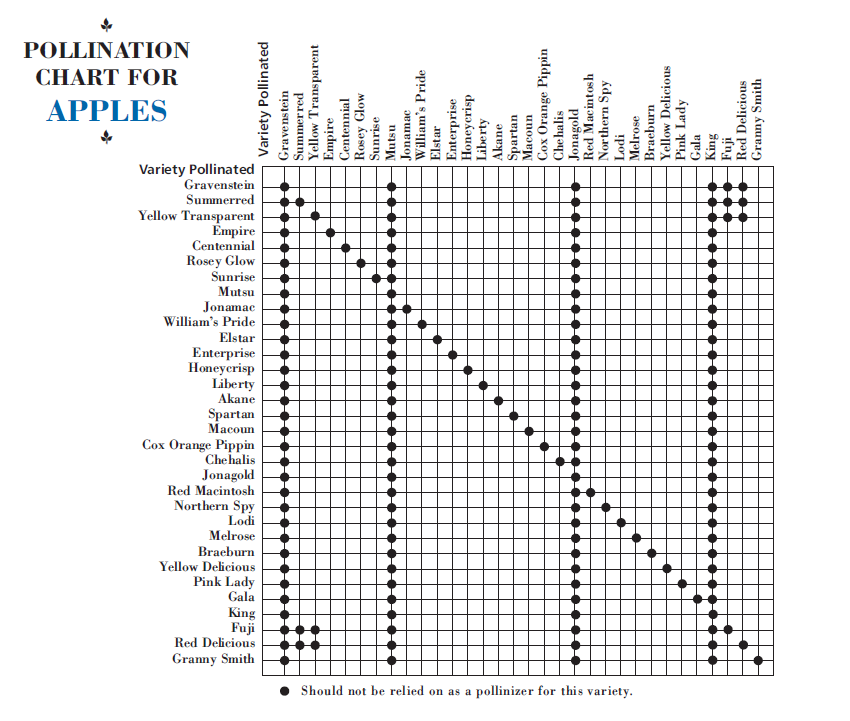
Most apples require another variety of apple or crabapple to produce fruit.
See chart at the end of document for more information.
Braeburn: Developed in New Zealand in the 1950s, the Braeburn is considered a dessert apple: juicy with a crisp texture, and a sharp and refreshing flavor that is sweet without being sugary. The skin is washed in shades of red and green – it was one of the first bi-colored varieties created! A WSU Mt. Vernon recommended variety for the Puget Sound. Matures late, keeps well. M26 rootstock.
Bramley: England’s favorite cooking apple. Large fruits are very tart, great for pies, sauce and cider. Whidbey Island’s go to apple! M106 rootstock
Cosmic Crisp: Developed by Washington State University and released in 2019, this apple is suited to the PNW. Mid to late season bloom, ripens in early October. The flavor is exceptional, both sweet and tart, making it an excellent apple for fresh eating. It is slow to brown once cut, has a long storage life, and holds its flavor well. Red in color with yellow flecks on the skin. M26 & M106 rootstock. Not pollinized by Honeycrisp or Enterprise.
Early Pink Lady (Maslin): Limb sport of pink lady. Large crisp, sweet tart apple. Pink blush, yellow skin. Early bloomer. Available on M106 rootstock.
Gala: The most popular apple in the world, a cross between Golden Delicious and Kidd’s Orange Red. This apple has pale golden yellow skin covered by a stripy red blush; flesh is juicy and sweet with hints of vanilla and a floral aroma. This is a great multi-purpose apple suited for fresh eating, juicing and cooking, but not storing. Late blooming, early to ripen. Mildew resistant. Included on Espalier #2
Gravenstein: Famous for sauce and baking, also great to use fresh. Early blooms, early harvest. Not to be used as a pollinizer. Available on M106 rootstock.
Honeycrisp: A modern apple with perhaps the best eating qualities in history. Medium to large, aromatic fruits are red blushed with yellow. Explosively crisp & juicy with a sweet-tart flavor. Excellent for fresh eating, cooking, storing and juicing! Fruit ripens in late September but becomes more flavorful if left on the tree into October. Good disease resistance. A WSU Mt. Vernon recommended variety. Available on 969 rootstock. Not pollinized by Cosmic Crisp.
Liberty: One of the easiest apples to grow, this variety should be included in all Whidbey orchards. It produces a bounty of medium sized, shiny red aromatic apples with yellow overtones. The very juicy fruit has crisp white flesh and a sweet, crunchy texture. Good for fresh eating, baking and cider. Ripens in late September and stores well. Very disease resistant. The tree tends to over-produce; thinning produces better quality fruit. A WSU Mt. Vernon recommended variety. M26 & M106 rootstock.
Spartan: McIntosh type dessert apple, but firmer. Stores well. Pure white flesh is crisp, juicy, highly aromatic and fine flavored! Early harvest. Available on M26 &M106 rootstock
Espalier
A tiered fruit tree with 3 different kinds of apple varieties grafted to one root stock, ensured to pollinate each other.
Espalier 2: Gala, Honeycrisp, Fuji (on M106 rootstock)
Espalier 3: Akane, Honeycrisp, Liberty (on M106 rootstock)
Combinations:4-way including Spartan, Honeycrisp, Pink Lady, Akane, Liberty on M106
Crabapple
Crabapples are excellent pollinizers for apple trees, as well as highly ornamental trees for the landscape.
Dolgo: A great pollinizer for most apples and one of the top choices for making crabapple jelly. Highly ornamental, very disease resistant, with large oblong crabs, and great for wildlife. M111 rootstock.
Apple Rootstock Guide
M106 (EMLA106): Semidwarf, typically 10’ – 13’ tall; tolerant of many soil types except for very wet soils; early production.
Geneva 969: Semidwarf, 50% of standard size so typically 12’ – 15’ tall. High resistance to Woolly Apple aphids and fire blight. Medium resistance to Crown and Root rot. Precocious and productive. Provide adequate drainage.
M26 (EMLA26): Vigorous dwarf, about 40 to 45 percent of a standard tree, usually around 12’-15’. Needs some support in early years but could be self-supporting in later years. Very early and heavy bearing. Adaptable for close plantings and double rows.
M111 (EMLA111): Dwarf; unpruned tree height 80-90% of standard. Excellent all-around rootstock for apples. Tolerates wet, dry, or poor soil. Resists Woolly Apple Aphids and collar rot. Induces bearing at young age. Trees on M-111 may be held to any desired height by summer pruning.