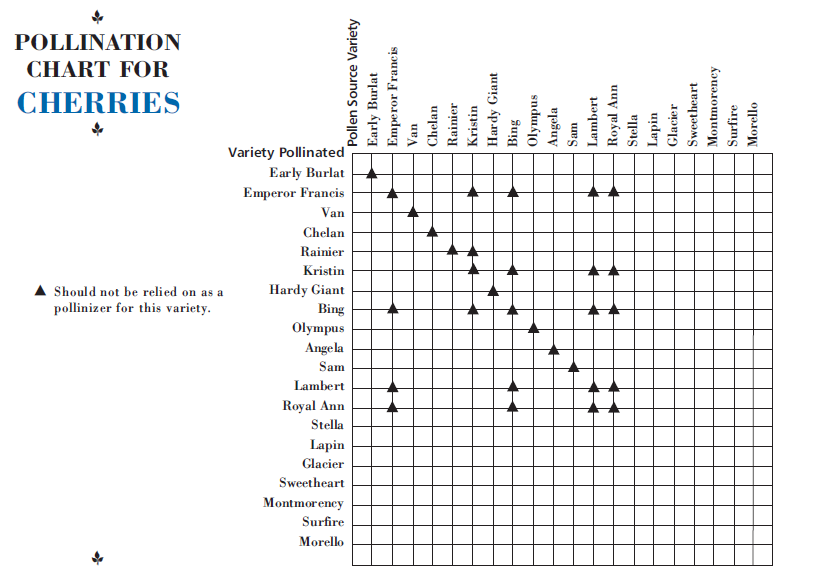
All our fruiting cherries are grown on dwarfing Gisela 5 rootstock (unless otherwise noted) to make them easier for bird netting and access to the fruit. Sour cherries (Prunus cerasus) are said to be self-fertile, but sweet cherries (Prunus avium) need a second sweet variety as a pollinizer. Since sour and sweet are different species, they do not pollinize each other.
Sweet Cherries (Prunus avium):
Bing: The most popular sweet cherry on the American market, Bing cherries produce large, dark smooth skinned fruit in mid-June to early July. The fruit is firm and extremely juicy and very sweet. Great for fresh eating, baking or preserves. One tree can be a heavy producer, with mature specimens producing 50-100 pounds of fruit in one year. A WSU Mt. Vernon recommended variety. Blooms early. NOT self-fertile; pair with Ranier, Lapin, Sam, or Van for pollination. Not pollinized by Bing.
Lapins: An outstanding sweet dark cherry for Northwest gardens. Fruit is very large and crack resistant, sweet and juicy, perfect for fresh eating or baking. Blooms early, ripens mid-season. Said to be self-fertile but fruit set can be improved with another variety such as Rainier or Bing. A WSU Mt. Vernon recommended variety.
Rainier: Large, delicious fruits are yellow with pink blush. Blooms early. Needs a pollinizer such as Bing, Lapin, or Royal Anne or Vandalay.
Royal Rainier: Large yellow cherry with a slightly redder blush than Rainier. Excellent flavor, taste test winner. Ripens early, about 3-5 days ahead of Rainier. Pollinized by Bing and Lapins. Maxma 14 rootstock.
Sweetheart: Van x Newstar. Large, bright red fruit with good flavor. Precocious trees require pruning to prevent size problems. Self-fruitful matures 5-7 days after Lapins.
Tart/Pie Cherries (Prunus cerasus):
Self-fertile but better with a pollinizer, sweet cherries will not pollinize sour cherries
Montmorency: Large, light red skin, yellow flesh. Perfect for cobblers, pies etc. This variety has been cultivated in this country since the early 20th century. Extremely winter hardy. Very heavy bearing. It is the most popular sour cherry in America. It produces a large fruit for baking, drying and juicing. Self-fertile.
Cherry Rootstock:
Dwarf Gisela 5: Dwarf 50-65% seedling size; early fruiting and productive; good frost and virus resistance, well-anchored, adaptable to a variety of soil types. Requires supplemental irrigation.
Maxma® 14: A dwarfing rootstock for sweet cherries; trees are dwarfed to about 2/3 of standard. Less dwarfing expected in fertile loamy soils. Induces early heavy bearing; crop management may be needed for productive varieties in early years. Good tolerance to wet soils. Resistant to bacterial canker and nematodes. Well anchored, very little suckering. Trees may be held to any desired height by summer pruning.