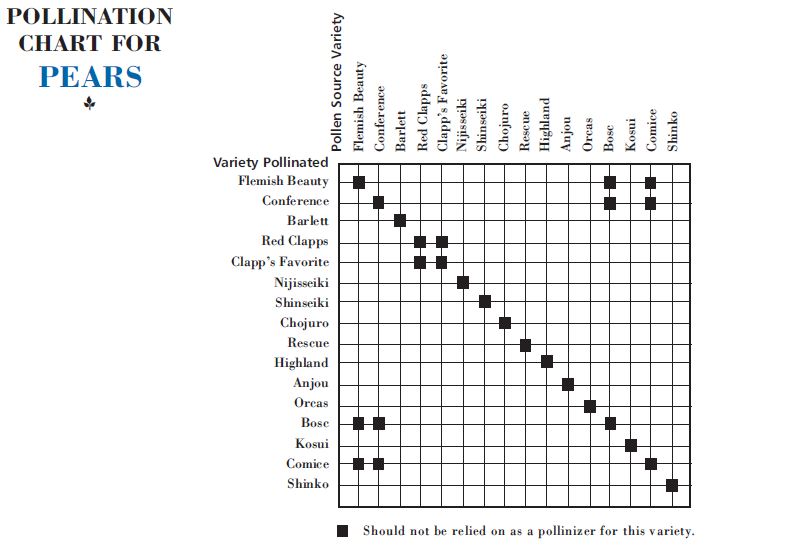
Most varieties of pear require cross-pollination with another pear.
While European pear can pollinize Asian pear, they typically are not in bloom at the same time.
Thus, it is recommended to have two varieties of European pear or two varieties of Asian pear.
A hybrid pear, such as Maxie, can act as pollinizer for both since its bloom time is between them.
European Pears
Bartlett: Perhaps the most widely grown European pear tree in history and cultivated in America since the early 1800’s. Classic bell shaped golden yellow fruit sometimes flushed red. Thin skinned, with creamy white flesh that is sweet and buttery. A multi-purpose pear grown for fresh eating, cooking, dessert, baking or juice. Ripens in September. Prone to scab. WSU Mt Vernon recommended variety. Early flowering; pollinize with Ubileen. Only available on espalier and 4-way grafted trees.
Orcas OHXF 97:The original tree was found on Orcas Island. Large, beautiful, perfectly pear-shaped yellow fruit, with a red blush. Sweet and juicy, with smooth, buttery flesh. Good for fresh eating, or for canning and drying. Reliable and productive. Disease resistant. Ripens in September. Pair with Comice, Maxie or Seckel for a pollinizer. WSU Mt Vernon recommended variety.
Rescue OHXF 97: Sensational appearance: very large fruits with distinctive reddish-orange blush and stripes over yellow. Smooth, buttery flesh is sweet with a mild, pleasing flavor. For fresh use and canning. Consistently productive. Self-fruitful.
Espalier European Pears & 4 way Grafted
Espalier European Pear 3 tiers: Red Bartlett, Bosc, Bartlett on Province Quince rootstock.
Combination 4-way: Bartlett, Flemish Beauty, Red Bartlett, Rescue, Anjou, Bosc on Province Quince rootstock.
Asian Pears
Nijisseiki: One of the most popular Asian pear varieties in the United States. Medium round, greenish yellow, firm, crisp and juicy, good quality. Latte august.
Shinseiki: A beautiful, rounded pear with showy yellow skin. Sweet white flesh is crisp and very juicy. Very vigorous and productive. Good disease resistance. Stores very well. Ripens in early to mid-August. Needs a different Asian pear variety, such as ‘Chojuro’, as a pollinizer. WSU Mt Vernon recommended variety.
Pear Rootstock:
OHXF 97: Vigorous, widely adapted and disease resistant. Unpruned tree height of fruiting varieties 15-25 ft. Trees on OHXF 97 may be held to any desired height by summer pruning.